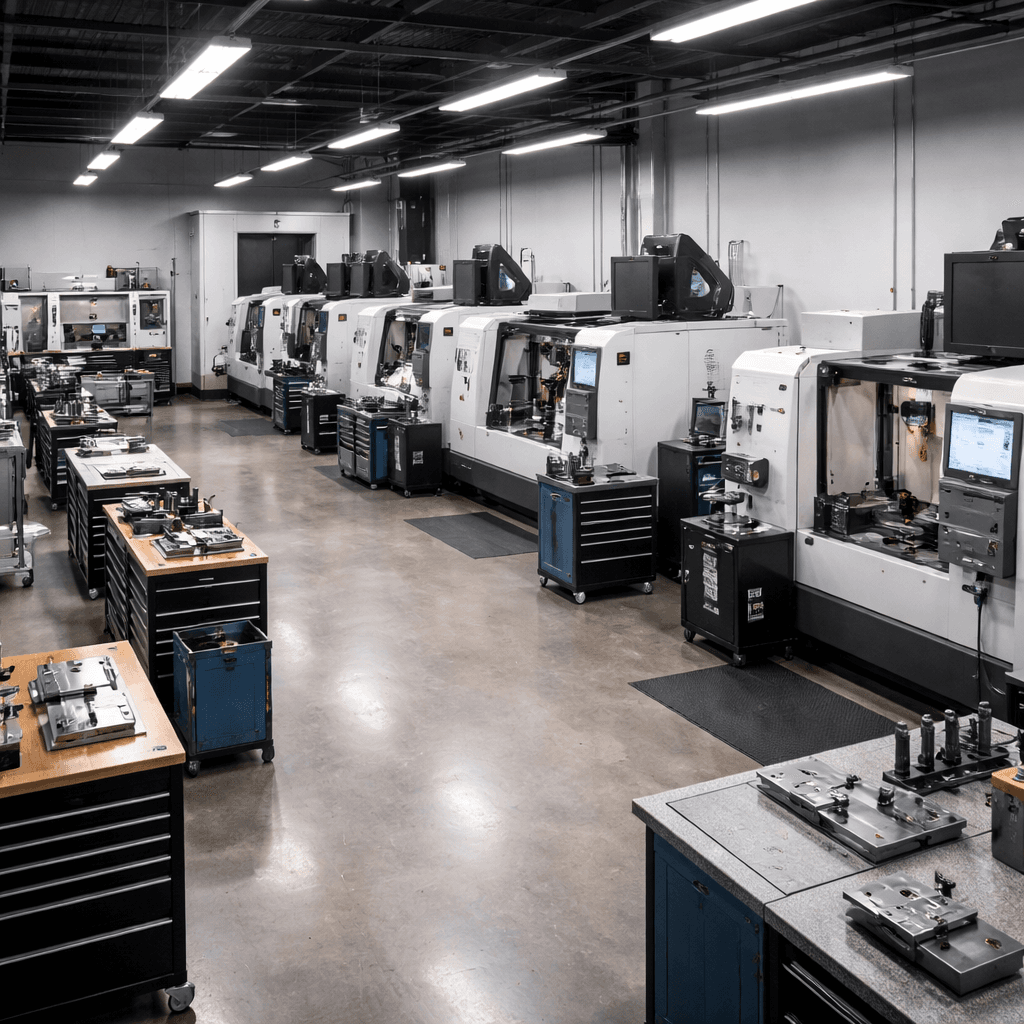
Shop Capabilities
The actual machine list. If you need to know whether your part fits, this page should answer it — and if it doesn't, call us.
Milling
One high-speed vertical for prototypes and larger work, two palletized horizontals for production.
Vertical Machining Center
Toyoda BM1200
High-speed vertical with a large envelope. Where most prototypes and larger aluminum work start.
- Travels
- 47.3" × 26.4" × 25.2" (1200 × 670 × 640 mm)
- Spindle
- CAT40, 12,000 RPM
- Tool changer
- 40 position
Horizontal Machining Center
Hitachi Seiki HG630
Twin-pallet horizontal for heavier work and repeat production. Setups stay fixtured between runs.
- Pallets
- Two 24.8" (630 mm)
- Travels
- 35" × 31" × 28"
- Spindle
- CAT50, 4,500 RPM
- Tool changer
- 60 position
- Max pallet load
- 2,200 lb
Horizontal Machining Center
Hyundai SPT H-400
Twin-pallet horizontal running at higher spindle speeds. Suited to tighter, faster production parts.
- Pallets
- Two 15.7" (400 mm)
- Travels
- 22" × 20" × 20"
- Spindle
- CAT40, 10,000 RPM
- Tool changer
- 60 position
Why the pallets matter to you
Both horizontals run twin pallets. In practice that means a fixtured setup can stay proven between runs — so the repeat order next quarter doesn't start over at first article. We can prototype a part on the Toyoda and move it to a pallet for production without changing shops, programmers, or inspection history.
Turning
Super-precision turning with live tooling and a Y-axis.
Super-Precision Turning Center
Hardinge RS-51MY
Live tooling and a Y-axis, so turned parts come off complete instead of moving to a mill. This is the machine behind our tightest tolerances.
- Bar capacity
- 2"
- Max turning diameter
- 11.4"
- Turning length
- 23.4"
- Spindle
- 5,000 RPM
- Turret
- 12 station, live tooling, Y-axis
About our tolerances
Typical work is held to ±0.001". We can go to ±0.0001" when a drawing calls for it — the Hardinge is a super-precision machine and that is what it was built to do. Tenths work is quoted case by case, with inspection scoped to the part rather than assumed.
Welding & Fabrication
MIG and TIG in-house, including AC TIG for aluminum.
AC/DC TIG
Miller Dynasty 280
AC capability means aluminum, not just steel and stainless. Precision TIG for thin wall and finish-critical weldments.
MIG / Pulsed MIG
Miller Millermatic 255
Pulsed MIG for clean, low-spatter welds and better control on thinner material.
3D printing, and knowing when not to machine
We run FDM and resin printers in the shop. We don't sell printing as a service — it's a tool we reach for when it beats cutting metal, and if you need something printed while we're working on your job, we'll take care of it.
More usefully: plenty of parts get machined that don't need to be. Fixtures, jigs, housings, form-and-fit checks — sometimes the right answer is a printed part for a fraction of the cost, or a printed iteration before you commit to metal. If that's your part, we'll tell you. Sending you a smaller invoice you were happy with beats sending you a bigger one you weren't.
Materials
Most work lands in the first column. The rest is doable — it just takes more planning up front.
Everyday Metals
- Aluminum (6061, 7075, 2024)
- Steel (1018, 4140, 4340)
- Stainless Steel (303, 304, 316)
- Titanium
- Brass & Copper
- Chromoly
Harder to Machine
- Inconel
- Hastelloy
- Monel
- Tool Steels
- Beryllium Copper
Send the drawing and we'll tell you straight whether it's a good fit.
Plastics
- Delrin / Acetal
- UHMW Polyethylene
- Nylon
- PEEK
- Polycarbonate
- PTFE / Teflon
Finishing & Secondary Operations
Surface finishes to 16 Ra, bead blasting, tumbling, deburring, and assembly and kitting in house. Anodizing, plating, and powder coating are coordinated through vendors we already work with, so your part comes back finished rather than becoming your problem to route.
Ready to Start Your Project?
Get a free quote from our team. We respond within 1 business day.